
What is a trading app with an agent, and why we're building one
30 September 2026 · Updated 22 October 2026 · 6 min read
In short
- A trading app with an agent is an app where AI researches the market and prepares the order, and you make the decision.
- In 2026 agent execution went mainstream: Robinhood, Coinbase and MetaMask all shipped products that let AI agents trade for users.
- The evidence so far says models are good at research and bad at the final call with money at risk. So we split the work exactly there.
- Sparkling is the trading app that comes with an agent: perps, prediction markets, tokenized US stocks and swaps from one self-custodial account. The agent never holds your keys and never trades on its own.
A trading app with an agent is an app where AI does the prep work for every trade (reading the market, explaining what is moving, turning your intent into a complete order) and hands you a ready-to-sign trade to approve. The agent handles the mechanics. You decide whether to trade, how much and when. Sparkling is built on that split, and this post explains why.
In 2026, agents learned to trade
Turning a sentence into a trade stopped being hard this year. Robinhood launched Agentic Trading in beta on May 27, starting with equities and later announcing crypto. Coinbase followed on June 11 with Coinbase for Agents, where users choose anything from a one-off recommendation to handing the agent a thesis and letting it run a strategy on its own. The same month, MetaMask opened Agent Wallet in early access, letting agents trade within limits set in advance.
Execution is now a commodity. What is not settled is trust. In June, members of the House Financial Services Committee sent the SEC a list of questions about agentic trading, including who is liable when an automated agent makes a bad trading decision: the broker, the AI developer or the customer.
What the evidence says about autonomous trading
- Models lose money when they trade alone. In Alpha Arena, eight frontier models each received $10,000 per contest across four contests trading US tech stocks for two weeks. The combined portfolio lost about a third of its capital, and a model finished in profit in only six of 32 results. The organizer's diagnosis is telling: the models were good at research and at picking the right tools, but mistimed trades, sized positions badly and traded too often. His verdict on handing an LLM money and letting it run: "that's not a thing yet."
- One misread number is irreversible. In February 2026, the autonomous agent Lobstar Wilde, a social bot rather than a trading system, tried to send a user about 4 SOL and instead sent its entire token holdings, worth roughly $250,000. Onchain, there is no undo.
- An agent with keys is a target. A security audit of the ClawHub skills marketplace found 341 malicious skills out of 2,857, many disguised as crypto wallet tools and Polymarket trading bots and built to steal private keys.
The pattern is consistent. Agents are strong at the work before a decision and weak at the decision itself. That is where we draw the line.
Where Sparkling draws the line
| The agent | You | |
|---|---|---|
| Research | Reads the market and explains what is moving | Ask anything, as often as you want |
| The order | Turns your request into a complete, ready-to-sign order | Edit any field |
| Size | Fills in what you asked for | Decide how much to risk |
| Execution | Never places a trade on its own | Confirm every trade |
| Keys | Never holds or accesses them | The only one who can sign |
Some apps take a middle road and let agents trade within limits set in advance. That is a reasonable model for strategies you can write down as rules. Most trading is decided trade by trade, and that is the case Sparkling is built for. For a deeper comparison, see Trading agent vs trading bot vs copy trading.
What it looks like in practice
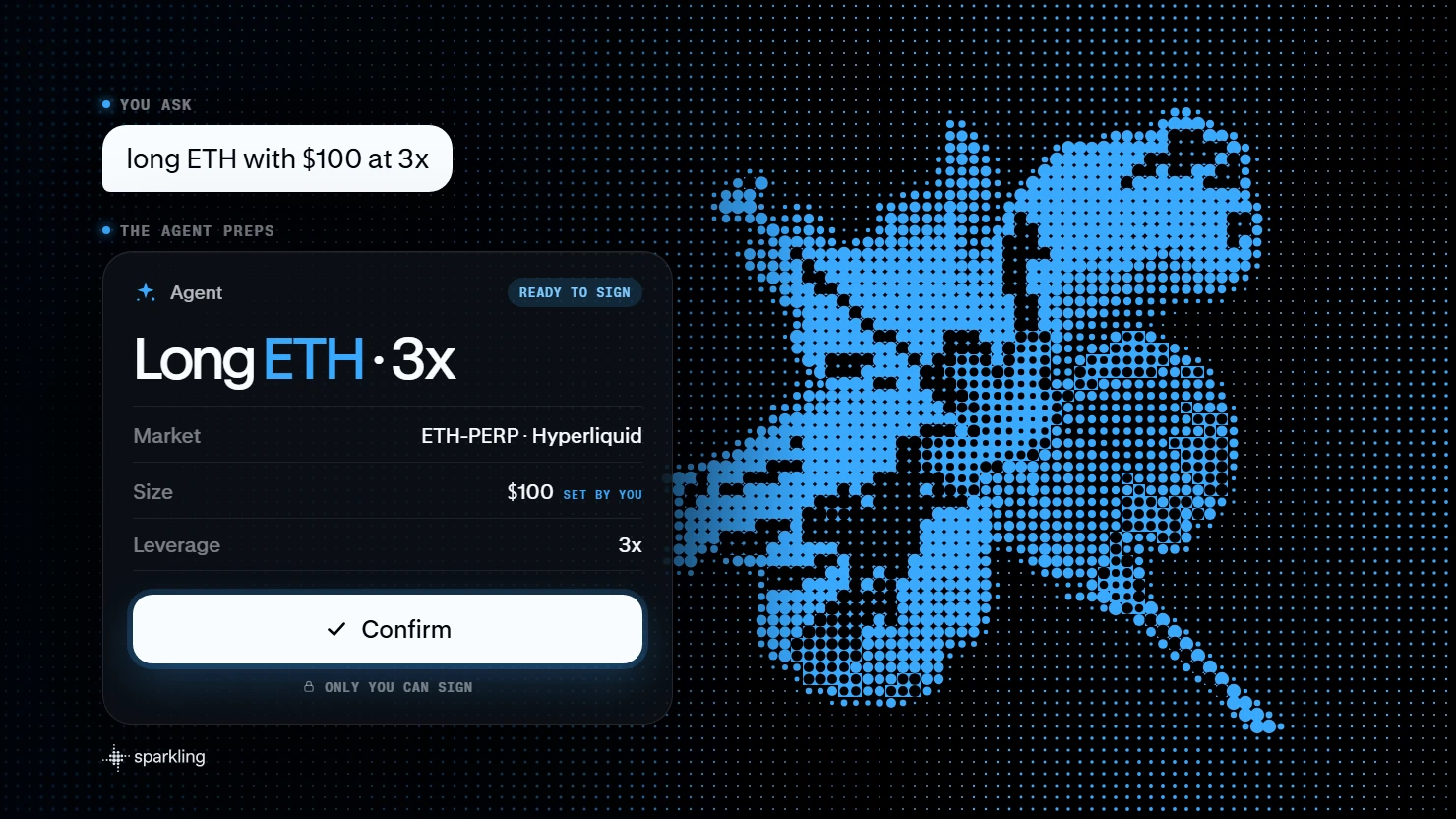
Type "long ETH with $100 at 3x". The agent turns it into a ready-to-sign order on Hyperliquid, shown in Sparkling's native trading interface with the market, side, size and leverage filled in. Change anything you like, ask the agent why ETH is moving, then confirm. Nothing moves until you do.
The same works across markets. "$20 on Bitcoin up for the next 15 minutes" becomes a ready order on a Polymarket Bitcoin Up or Down market. And if you already know exactly what you want, skip the agent and trade directly in the interface.
What you can trade
- Perpetual futures on Hyperliquid and Lighter.
- Prediction markets on Polymarket, where Sparkling is a verified builder.
- Tokenized US stocks from xStocks.
- Cross-chain swaps powered by Bebop.
Every account is self-custodial from the first deposit, with no seed phrase to write down at signup. Sparkling is available on the web and in Telegram.
Frequently asked questions
What is a trading app with an agent?
It is an app where an AI agent does the prep work for a trade (reading the market, explaining what is moving and preparing a complete order) and presents it as one decision you approve. The agent does the work; you make the call.
Does the agent trade on its own?
No. Every trade is a proposal until you confirm it, and only you can sign.
How is a trading app with an agent different from agentic trading on Robinhood or Coinbase?
Agentic trading products let an agent execute trades for you, sometimes within limits you set. In Sparkling, the agent prepares the trade and you confirm every one of them.
Which markets can I trade in Sparkling?
Perpetual futures on Hyperliquid and Lighter, Polymarket prediction markets, tokenized US stocks from xStocks and cross-chain swaps. For how Sparkling compares with MetaMask, Phantom, Trust Wallet and FOMO, see our app comparison.
Perpetual futures, prediction markets and tokenized stocks involve substantial risk, including the loss of all funds. Trades prepared by the agent are not recommendations; every decision is made by the user. Some services are not available in certain jurisdictions, including the United States and the United Kingdom.